
Twenty-five years after the first edition in 2001, 31 participants from 16 European countries have gathered in Cluny this week to reflect, debate and negotiate around a timely theme:
Negotiating the Future of “Greater Europe”:
What Challenges for 2040?
As at every Summer University in Cluny, participants are tasked with drafting a final document that brings together the conclusions and key outcomes of their work. This requires method, compromise, and organization—in short, negotiation.
Deliberative Process
The Cluny 2040 Declaration is the outcome of a deliberative exercise designed primarily to put into practice the lessons participants learned throughout the Summer School—particularly during sessions focused on negotiation, collective decision-making, and participatory processes.
Work began with a preliminary draft of the declaration, organized into ten principles and divided among five thematic committees, each responsible for two principles. Participants were free to join the committee of their choice using the “Open Space” method, based on their interests and the contributions they wished to make.
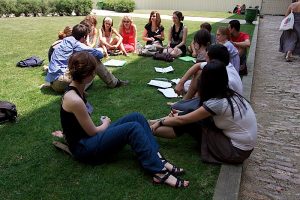
Within each committee, students debated, negotiated, amended, and expanded upon the principles assigned to them. Each committee’s proposals were then presented and discussed in a plenary session.
Each committee subsequently appointed a representative to a drafting committee tasked with integrating the various contributions into a single, coherent text that faithfully reflected the committees’ work.
This consolidated version was ultimately presented, discussed, and approved during the final plenary session in Cluny. The value of this declaration lies not only in the final text—which represents a significant collective contribution—but above all in the process that led to its creation. This exercise allowed participants to gain hands-on experience with the challenges of negotiation, consensus-building, managing divergent viewpoints, and decision-making within a complex context. The Cluny 2040 Declaration thus stands as both an outcome and a genuine learning laboratory for participatory governance and collective negotiation.
To mark its 25th anniversary, the Cluny Summer University offers an intensive four-day format, bringing together a select group of participants from across Europe and with diverse professional and academic backgrounds.
The programme is built on a demanding experiential learning approach, combining:
- Simulations based on real-life situations
- Work in multicultural teams
- Exchanges with practitioners and researchers
- Meetings with local stakeholders
2026 topic
Negotiating the Future of “Greater Europe”:
What Challenges for 2040?Why this programme?
What if Europe’s future was shaped less by decisions than by the way they are negotiated? By 2040, Europe will not transform itself through isolated decisions, but through a series of complex, uncertain, and interdependent negotiations. In such environments, agreements are based not only on strong arguments, but also on the ability to:
- understand divergent interests,
- structure disagreements,
- build robust and sustainable solutions
Negotiation is no longer a specialized skill. It is becoming a structuring capability for contemporary societies, at the intersection of political, economic, and institutional challenges.
This summer school is not a course!
It is a European laboratory dedicated to the negotiation and transformation of Europe by 2040.
A demanding experience to think and act in complexity

Dates
From Wednesday 8th July to Sunday 12th 2026
Official opening on Wednesday, July 8 at 6:00 PM (check-in starting at 4:00 PM); departure on Sunday, July 12 in the
early afternoon.
This programme is for you if:
- You are an advanced student (Master’s or PhD) or a professional (public sector, private sector, NGOs, European institutions) with an interest in European and international issues
- You are comfortable working in multicultural environments
- You want to develop your ability to act in complex situations
Key criterion: ability to actively engage in a demanding collective dynamic within a small group of 25–30 participants
Why join us?
- Become part of a committed and selective European group
- Work on real and contemporary challenges
- Develop a rare skill: negotiating in complex environments
- Contribute to a collective reflection on Europe in 2040
- Join a demanding and forward-looking European initiative

Programme
Thursday, July 9 – Understanding
Analysis of negotiation systems in Europe, identification of stakeholders, interests, and power dynamics.Friday, July 10 – Structuring
Development of scenarios and negotiation strategies
Responsible use of AI in diplomatic contextsSaturday, July 11 – Negotiating
Intensive simulation in multicultural teamsSunday, July 12 – Evaluating
Debriefing and reflection on key learnings
Presentation of the Cluny Declaration for Europe 2040
Content:
Participants will be placed in situations closely resembling those faced by public, economic, and diplomatic decision-makers. The objective is to develop sound judgment in real-world conditions, dealing with complexity, pressure, and uncertainty. The programme will enable the development of the following competences:
- Strategic thinking in uncertain environments
- Analytical and structuring skills for complex situations
- Ability to work effectively in multicultural teams
- Negotiation posture and sense of responsibility
- Diplomacy, mediation, and negotiation
These competences are approached as integrated capabilities that can be directly applied in real-world, demanding contexts.
Participants will explore the ongoing transformations of “Greater Europe”, with a focus on:
- The European Union’s enlargement process
- Interactions between local, national, and European levels
- Political, economic, and institutional constraints
- Managing uncertainty
Working Language
The working language of the programme will be English. A minimum level of B2 is required. A basic understanding of French would be an asset (but not a prerequisite) to facilitate local interactions.
Method
The “Cluny method” is the development of collective intelligence that makes use of interdisciplinarity and plurilingualism. The facilitators will invite the participants to develop their autonomy and their self-learning abilities, to appropriate innovative methods of co-construction based on mutual learning.
Conference, training sessions and working groups will enable you to develop negotiation skills and to gain an overview of the main issues at stake.
How to apply?
Please send your application by email to contact@collegecluny.eu, including:
- A short cover letter
- A CV
Apply now! Application deadline: May 15, 2026
As places are limited, particular attention will be paid to the quality and diversity of selected profiles.
Selection criteria
- Born between January 1, 1991, and January 1, 2008
- Candidates’ background, motivation, and ability to contribute to a collective dynamic
- Geographic distribution
- Language proficiency
Registration fees
- Registration fee: €280 (includes tuition, visit, accommodation and meals within the Abbey).
Note: Travel expenses are the responsibility of the participants, but bursaries of up to 50% of travel costs up to a maximum of 200 euros are available. When applying, please include an estimate of your travel expenses.
NB: The bursary will be paid after the summer school upon presentation of the corresponding receipts.
Official opening on Wednesday, July 8 at 6:00 PM (check-in starting at 4:00 PM); departure on Sunday, July 12 in the early afternoon.